Perspectivas is edited by
Perspectivas, journal of history, gegraphy, art and culture, publicly recognizes the ethical commitment and good practices of all parties involved in the intellectual development process, the author, the peer reviewers and the members of the Editorial Committee, who undertake to take reasonable measures to identify and prevent the publication of manuscripts in which cases of bad practices have been detected. Therefore, this code was developed based on the criteria published in: Best Practice Guidelines for Journal Editors, of the Committee on Publication Ethics (COPE), the Singapore Declaration on Research Integrity and the principles on the responsible use of artificial intelligence proposed by the Heredia Declaration, all of which are internationally recognized .
In accordance with section 2 of COPE and the Singapore Declaration, Perspectivas guarantees that all published articles are reviewed by members of the Editorial Committees, selected according to the topics, adopting processes with precision, integrity and clarity, to guarantee transparency in the evaluation process, fairly based on the intellectual content of the article and under the double-blind system, for subsequent dissemination.
Responsibility of the authors
Perspectivas is committed to maintaining contact with authors to publish clear and precise instructions on the publication process and standards; Thus, taking into consideration the COPE, the Singapore Declaration and the Heredia Declaration, the respective documents are reviewed, updated periodically and are published in different formats that allow downloading.
The authors undertake to comply with the publication standards available on the journal's web portal and the criteria mentioned below:
Submission of work
Authors submitting original research manuscripts must present an adequate account of the work performed, as well as an objective discussion of its relevance. The data must be presented faithfully in the manuscript. This should contain sufficient details and references to allow others to replicate the work. Fraudulent or knowingly inconsistent assertions constitute a form of immoral behavior and are therefore unacceptable.
Data access
Authors may be asked from time to time to provide the original data of their work, so they must be ready to offer public access to it. They should also be prepared to allow access to such data even after the manuscript has been published.
Copyright
The authors transfer to Perspectivas the rights over the articles prior to publication and, therefore, all the content of the journal will be freely accessible, distributed and published under the Creative Commons license (BY-NC-SA) in different formats. downloadable, you can disseminate them in databases, libraries and the like at a national and international level.
Originality and Plagiarism
All nominated articles must be accompanied by the Declaration of Originality, signed by each of the authors, in which they certify that the manuscript is completely original and that textual citations of statements or parts of works that belong to other authors are explicitly recognized. in the text, through the corresponding mechanism of citation and references published on the journal's portal. Copying other people's works that appear in the manuscript as your own will be considered plagiarism, which represents serious intellectual immorality, and will therefore be rejected.
Multiple post
In general, the author should not submit manuscripts dealing with essentially the same topic and with the same approach to more than one journal or similar publication. Submitting the same manuscript to more than one journal constitutes an immoral practice and is, therefore, unacceptable.
Source recognition
In all cases, the author must explicitly acknowledge the work of others and cite publications that by their nature have been influential in the work carried out.
Authorship of the manuscript
Authorship is limited to those who have contributed substantially to the conception, design, execution or interpretation of the research. All who have contributed in this way should be listed as co-authors. The collaboration of other individuals who have contributed in some other way must be recognized. One of the authors must be in charge of communication with the journal. He or she must ensure that all co-authors have been included in the manuscript in its final version, that no inappropriate individuals appear as co-authors, and that everyone agrees to its publication.
Responsibilities of the Director, Editors and Editorial Committee
Perspectivas has researchers from various areas of knowledge who make up the Editorial Committee, qualified professionals who contribute to the good management of the journal. The director, the editors and the editorial committee ensure thorough review of manuscripts and adherence to the journal's editorial policies. If AI is used in any part of the editorial process, this must be evidenced in accordance with the principles established in the Heredia Declaration on the editing role. Thus, the editorial team is guided by these values:
Honesty: transparency is guaranteed in the evaluation, editing and publication processes of each issue.
Confidentiality: The editorial team will maintain anonymity between reviewers and authors throughout the process.
Respond to concerns via email: Queries and clarifications requested by authors, reviewers or any interested person will be answered promptly.
Facilitate rectifications: Corresponding corrections or clarifications will be published via email and the journal's website, in the authors' section.
Dissemination: The published issue will be disseminated to repositories, databases, recognized catalogues, editorial collections and social networks.
Publication process: as specified in section 3 of COPE, the editors will critically select the most capable reviewers for the evaluation of the articles.
Conflict of interest and disclosure: Perspectivas assumes what is suggested by COPE in its section 14, so policies are adopted for the management of submissions, in such a way that impartial reviews are guaranteed. The editors undertake not to use content from articles submitted for publication in their research without the written consent of the author.
Respect for time: The editors are responsible for compliance with the time limits for reviews and publication of accepted works, to ensure rapid dissemination of scientific results. They reliably commit to meeting the published times (maximum of 4 weeks in the estimation/dismissal from receipt of the manuscript in the Review Platform and maximum of 12 weeks from the beginning of the double-blind review process).
Responsibility of peer reviewers
In line with sections 7 and 8 of COPE and the Singapore Declaration, Perspectivas ensures that peer reviewers guarantee the quality and academic integrity of the information contained in the manuscripts; therefore, the selected peer reviewers are responsible for proposing corrections and improvements, and approving or rejecting the publication of the work. If AI is incorporated, it will only be used as a complement to the review, with prior participation of the editorial team and in compliance with the principle regarding the review role of the Heredia Declaration in its section 8.
The selected peer reviewers meet the following criteria:
Arbitration: The arbitration process, peer evaluators are committed to helping the editor when making decisions, as well as helping authors to improve the quality of their manuscripts, in relation to: methodologies, presentation of results, arguments, conclusions generated that allow establishing the coherence and certainty of the information presented, as well as the relevance and contribution to knowledge of the area. Any professional peer review who does not feel qualified to review the assigned manuscript or who feels unable to provide a timely review of the manuscript must notify the editor and excuse himself from the review and arbitration process.
Confidentiality: Manuscripts received by peer reviewers must be treated as confidential documents. They should not be shown or discussed with other individuals, except those individuals designated by the editor from time to time.
Objectivity standards: Arbitrations must be carried out objectively and impartially. They should not contain personal criticism of the authors. Professionals peer review must clearly express their opinions, comments or observations relevant to the manuscript, as well as explain their rationale.
Recognition of sources: The professionals peer review are in charge of identifying relevant works on the topic that have not been cited by the authors. Any statement that has been verified in a previous publication or work must be accompanied by its corresponding citation. The Professional peer review must also inform the editor if the manuscript has substantial similarities with other works of which he is aware.
Conflict of interest: Professional peer review should not evaluate manuscripts that do not include the conflict of interest statement signed by the authors.
Perspectivas is edited by
Present to share with you our intellectual productions
Perspectivas is governed by the principles of Diamond Open Access: Towards Science as a Global Public Good. That's why we're part of the Redalyc Scientific Information System.

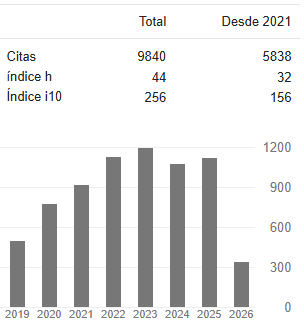
Métricas Google Scholar


294 record